
1. Research studies show that: preschool children, intellectually limited, and neurologically impaired people (stroke, dementia, etc.) are often under-treated for pain. That experience shapes their response to future pain. The fear response can make their care costly in several ways. (see Annotated Bibliography in My Pain Alert® Book for references.)
2. Standard 10-point pain scales were created when most patients had “a” doctor who knew them well and treated most of their issues. Now people are seen by many specialized providers. Revisions have been made by researchers and providers to make the10-point scales’ use easier. Less has been done to support the patient’s use experience. The bar for functional use is still high.
3. Gail, Speech Language Pathologist (SLP) author of My Pain Alert® Scale (MPAS), worked in rural locations where she was the first SLP to treat individuals with communication disorders. She saw people whose pain was not controlled due to the patient’s inability to tell pain care needs; some patients were destructive.
4. The commonly used scale with emojis was created by nursing students in 1988 as research project targeting children age 8+ who had chronic pain. Age 7 is when children begin to make sense of abstract concepts. Concepts like time and pain are abstract, not concrete. Children under 8 years old experiencing pain don’t understand their pain as a concept to which they should apply a rating number. Significant pain to them is a never-ending horror.
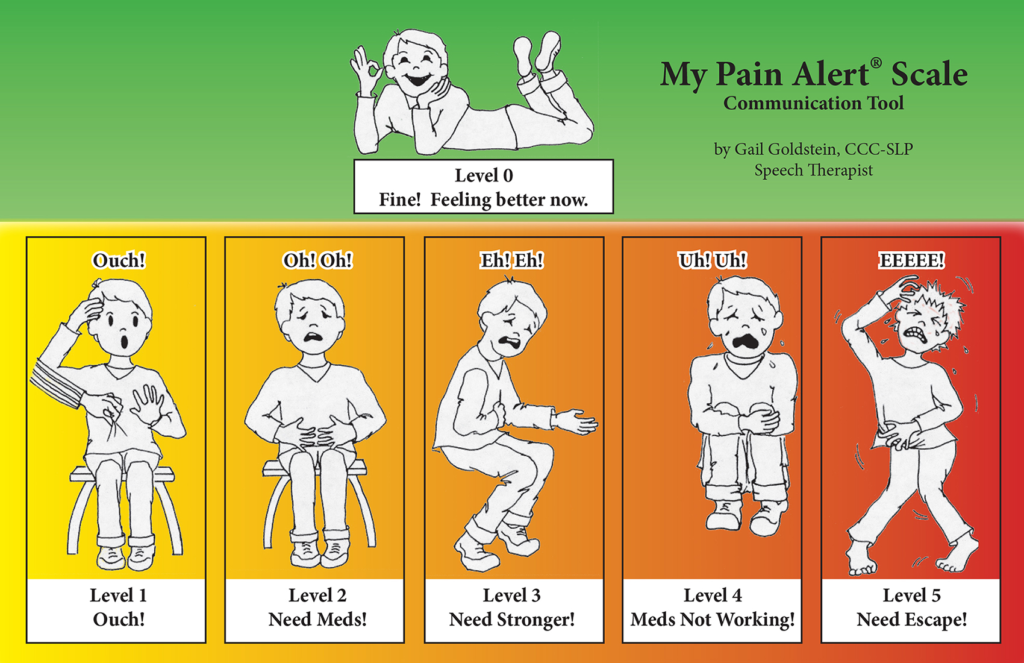
5. When a toddler in her family was expected by a nurse to use those pain rating directions, Gail was motivated to create a pain scale ALL people could use, given support and practice materials. The idea that the cartoon-like emojis of face-type pain scales make them useful for communication challenged people is not supported by experience. Some healthcare guidelines still suggest parents start children with acetaminophen for any pain experienced, giving up on the idea that children can tell what they need. The story tool this SLP created changed the home life of the toddler in her family. Once he understood he could get relief by communicating with My Pain Alert® Scale (MPAS), he alerted Mom as soon as the pain started. Other families trying the original My Pain Alert® Scale Communication Tool book reported their children bought-in to MPAS use quickly. They also reported less stress for child and family with subsequent pain events.
6. Many people are not at their best for communicating when faced with an injury or other pain care need. MPAS makes communicating pain needs easier for most patients. Prior pain experience is not required. Practice can be provided without pain. My Pain Alert® Book is the post field trial revision of the original book. It has the same practice stories for using each pain level. The story practice can be responded to by: pointing to pictures, using simple sign language, or participation in an interactive song.
7. When a patient attends but does not respond with a pain level, this method is suggested: medical professional/caregiver picks 2 likely levels. They read the descriptions (on the Word side of the card for adults or from the stories) pointing to the pictures for each level. Then ask which is your pain?
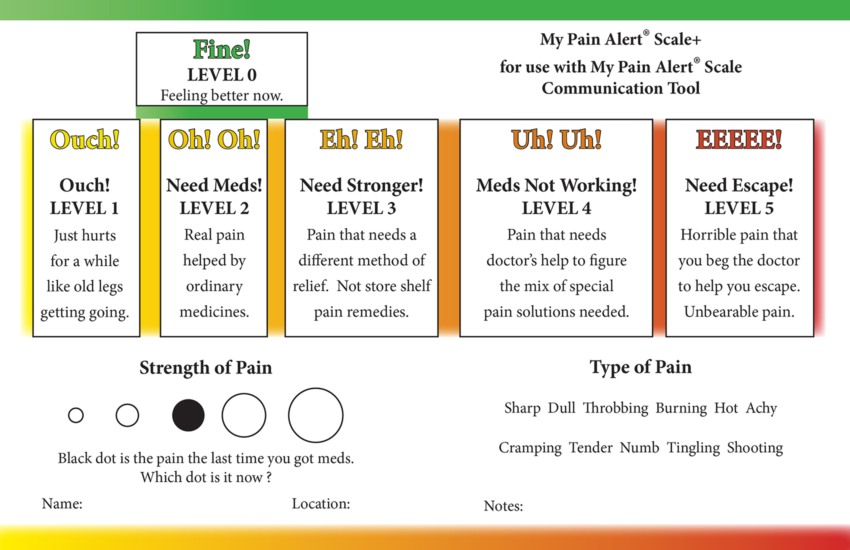
8. A word bank of common pain describers is included on the Word side of MPAS card reducing the task of describing type of pain to choosing the best descriptor.
9. My Pain Alert® Scale is an intentional “overlay” on the standard 10-level pain scale. MPAS can be used where traditional pain scales are used, documenting the level number selected multiplied by 2. If the assessing caregiver feels some emphasis is needed, they can add MPA words to their numeric note such as: “Patient indicates level 6 of 10 pain – needs stronger medicine.”
10. Emojis are not used. Some autistic and/or near-vision impaired people struggle with differentiating them. Rating pain from personal history requires patient’s use of their working memory. Full-body icons of feeling better and 5 pain levels paired with keywords takes less patient effort to respond.
11. A world-wide Delphi survey of professionals who treat children with pain asked what areas needed improvement. Medical professionals specifically targeted the area of children’s understanding of “pain.” (Rheel, E. j Pain 2025, 26, 104703.)
12. All of the My Pain Alert® books including Bea-the Best Kind of Patient have the pain level stories and sign language describing each level. The My Pain Alert® Book e-publication can be downloaded through our shop for pain communication tools. Its second page is the word side of My Pain Alert® Scale (pictured above). It is available: on Kindle, through Apple books, and in Android format via https://www.kobo.com/. These E-publications are priced at $3.99
13. Presenting the My Pain Alert® Scale training in a cellphone book download was chosen intentionally to support caregivers with a pain communication tool available at all times. The low price of My Pain Alert® Book download was also intentional. Providing a pain communication tool which is age-appropriate to use in public, for adults with intellectual disabilities or memory issues was one of our goals. Developing an “app” was suggested, but was beyond our resources and support.
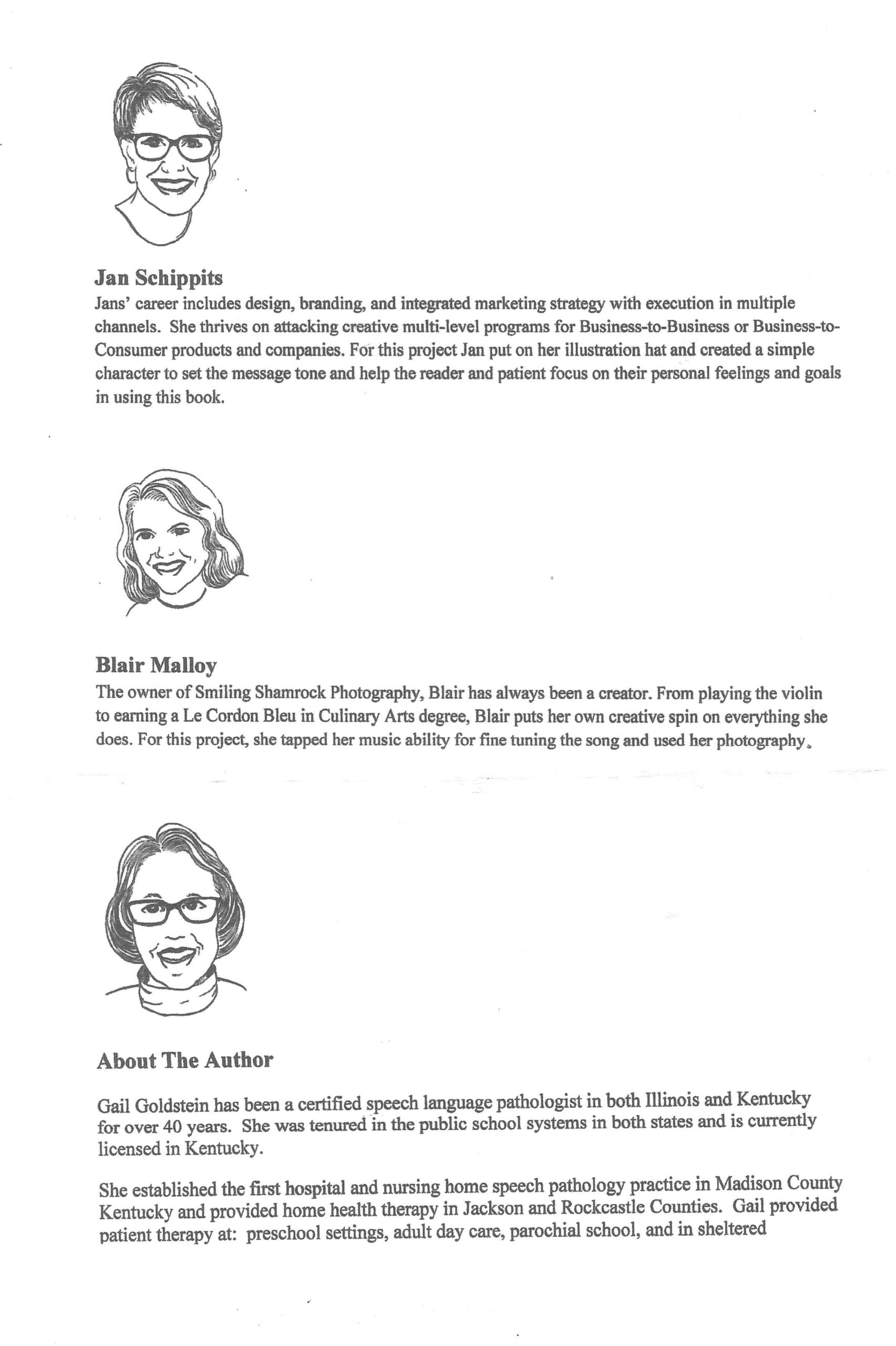
Thank you for your interest. We (Gail, Blair, and Jan) hope these tools meet your patient’s needs. Your reviews are a cherished gift.
Subscribe to MPAS blog to give us input.